
Pitigliano, Sorano and Sovana: The Etruscan Villages of Southern Maremma
The Etruscan villages of Pitigliano, Sorano and Sovana lie in the southern part of Tuscany, close to the border with Lazio, in a rural area shaped by volcanic tuff rock, deep valleys and ancient road systems.
These three villages are closely linked by geography and history. All were important Etruscan settlements more than 2,500 years ago. They later developed under Roman influence and during the medieval period, when fortifications, cathedrals and noble residences were constructed.
Today, they are frequently visited together. They are located within a short driving distance of one another, yet each offers a distinct character and atmosphere. Visiting them provides a clear introduction to the layered history of the southern Maremma, from Etruscan civilisation to medieval Tuscany. They form part of the wider cultural landscape explored across southern Tuscany.
Pitigliano
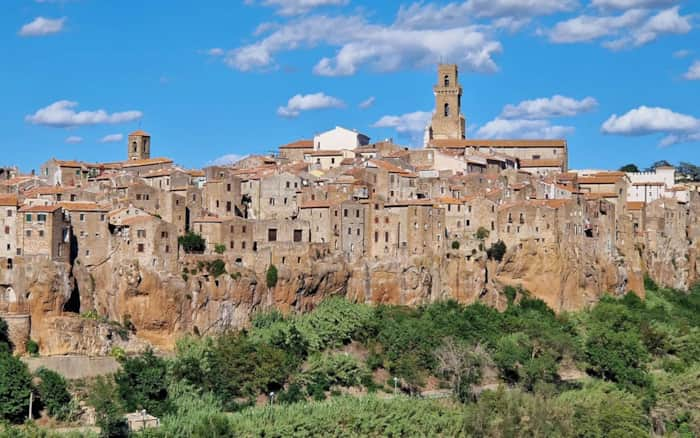
Pitigliano is the largest and most visited of the three villages. It stands on a long ridge of volcanic tuff stone, with houses built directly into the rock, forming a dramatic skyline that rises above the surrounding valleys.
Originally an Etruscan settlement, Pitigliano later became an important Roman centre and then a Renaissance town under the Orsini family. Architectural elements from these periods remain visible in the historic centre. The town is also known for its historic Jewish community, and the restored synagogue and Jewish quarter reflect this aspect of its past.
Pitigliano offers the widest range of cafés, small restaurants and shops among the three villages. Visitors typically allow half a day to explore the narrow streets, viewpoints and historic buildings.
Pitigliano suits travellers who are interested in:
- A larger historic centre
- Strong visual impact and panoramic viewpoints
- A mix of history and everyday Tuscan life
Sorano
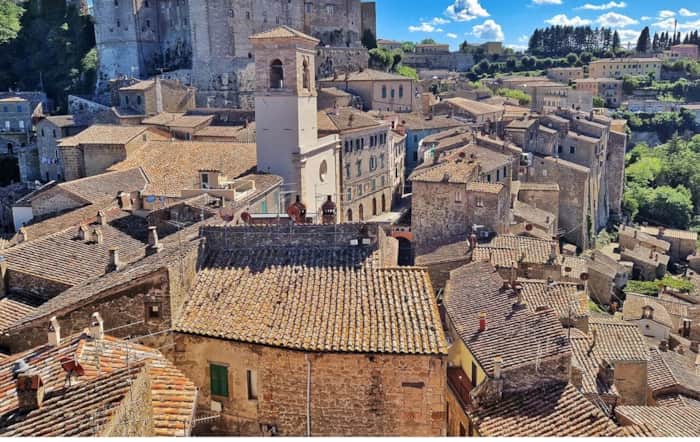
Sorano lies a short drive from Pitigliano and has a quieter, more rugged character. The village rises steeply above a deep valley and is dominated by the Fortezza Orsini, a Renaissance fortress that overlooks the town and surrounding countryside.
Like Pitigliano, Sorano has Etruscan origins, but it feels less commercial and more residential. The stone houses are closely integrated into the volcanic rock formations, and the streets are often stepped and narrow.
Sorano is also known for access to the ancient Etruscan hollow roads, known in Italian as vie cave. These sunken routes, cut deeply into the tuff stone, can still be walked today and connect the countryside between Sorano and Sovana.
Visitors often combine Sorano with countryside walks or a visit to nearby thermal springs. The atmosphere is slower, with fewer shops and restaurants than in Pitigliano.
Sorano suits travellers who are interested in:
- A quieter setting
- Strong medieval character
- Direct access to historic walking routes
Sovana
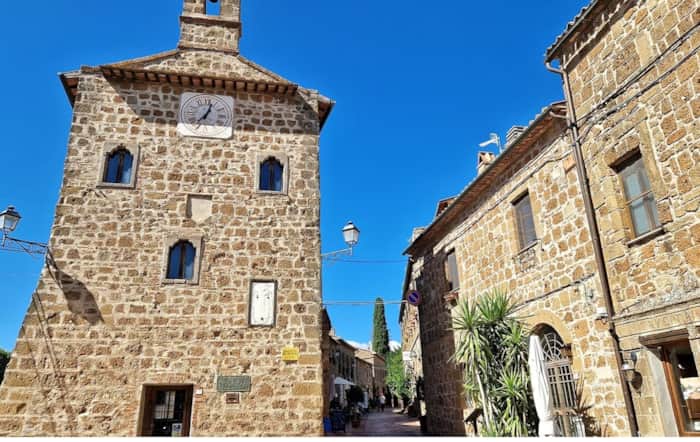
The Duomo of Sovana
Sovana’s cathedral, dedicated to Saints Peter and Paul, dates primarily from the 11th and 12th centuries. It is a Romanesque structure built in local tuff stone and stands slightly apart from the main village square. Sovana was once an episcopal seat, and the cathedral reflects its historical importance during the medieval period.
The interior is simple and restrained, with early medieval architectural features and a carved ciborium that is frequently noted as one of its most significant elements.
The Etruscan archaeological area
Just outside the village are several Etruscan necropolises, including monumental tombs carved directly into the volcanic rock. Among the best known are the Tomba Ildebranda and the Tomba dei Demoni Alati.
These tombs date from the 3rd to 2nd centuries BC and illustrate the scale and technical sophistication of Etruscan funerary architecture in this region. The archaeological park can be explored on foot along marked paths.
The “vie cave” or 'hollow roads'
The surrounding countryside contains numerous ancient sunken roads known in Italian as vie cave. In English they are commonly referred to as hollow roads or sunken roads.
These narrow passages were cut deeply into the soft volcanic tuff, in some places forming vertical walls several metres high. Their exact purpose is still debated, but they are widely attributed to the Etruscan period and were later reused during Roman and medieval times.
Walking through these "vie cave" provides direct evidence of how the Etruscans shaped the landscape and connected their settlements.
Sovana suits travellers who are interested in:
- Romanesque architecture
- Etruscan archaeological sites
- A compact and calm historic village
Which village should you choose?
Although they share Etruscan origins, each village offers a different experience.
Pitigliano suits travellers who prefer:
- A quieter setting
- Strong medieval character
- Direct access to historic walking routes
Sorano suits travellers who prefer:
- Fewer visitors
- A fortress setting
- Walking access to historic hollow roads
Sovana suits travellers who prefer:
- A smaller, easily walkable villag
- Romanesque architecture
- Ready access to Etruscan tombs
Many travellers choose to visit all three over one or two days to understand the contrasts between them. This summary table brings together the key characteristics of each village at a glance.
| Village | Overall character | Best for | Time needed |
|---|---|---|---|
| Pitigliano | Larger hill town with dramatic skyline and more services. | First-time visitors, mix of history and everyday life, cafés and restaurants. | Half a day or more. |
| Sorano | Quieter, rugged medieval village beneath a fortress. | Travellers who like fewer crowds, medieval atmosphere, access to vie cave walks. | Half a day, longer if walking the vie cave. |
| Sovana | Small, calm village with a single main street and cathedral. | Romanesque architecture, Etruscan tombs, compact and relaxed visit. | One to two hours, plus extra time for archaeological park. |
A countryside base for exploring the Etruscan villages
The Etruscan villages are typically explored by car during the day. Parking within the historic centres can be limited, and evenings are often quiet once day visitors depart.
Podere Sant’Angelo is situated at around 700 metres above sea level in the rural hills of the southern Maremma, within practical driving distance of Pitigliano, Sorano and Sovana.
Staying in a countryside setting allows visitors to:
- Explore cultural sites during the day
- Combine village visits with walking or e-biking
- Visit the Saturnia thermal springs on a separate day
- Return in the evening to a quieter rural environment
For travellers interested in history, landscape and slow exploration, this combination of cultural access and countryside quiet defines the experience of southern Tuscany.
Stay in the countryside near the Etruscan villages
If you are looking for a quiet countryside base near Pitigliano, Sorano and Sovana, Podere Sant’Angelo offers three one-bedroom holiday apartments within driving distance of all three villages. Podere Sant’Angelo has been rated 9.9/10 by guests on Booking.com in 2026 and is designed for couples seeking quiet, independent stays in southern Tuscany. The three apartments:
Albegna
Ground-floor apartment in the main farmhouse with a covered portico and direct access to the surrounding landscape. Suitable for couples seeking easy access and outdoor space for dining.
-
One bedroom
-
Private outdoor seating area
-
Views over rolling hills
-
Comfortable base for day trips to Pitigliano, Sorano and Sovana
View details and availability →
Capitorio
Apartment in a restored stone barn with a west-facing terrace bordered by lavender. Elevated position with wide views and evening light.
-
One bedroom
-
Private terrace
-
Quiet rural setting
-
Within 40 minutes of the Etruscan villages
View details and availability →
Zolferate
The most private apartment, located in the stone barn with its own terrace and independent entrance. Often chosen by couples looking for seclusion and uninterrupted countryside views.
- One bedroom
- Private terrace
- Strong sense of privacy
- Practical base for cultural exploration
View details and availability →
Why book directly with Podere Sant’Angelo?
- Best Price Guarantee
Save money — no commissions or hidden fees. You always get the lowest rate here. - Direct Contact
Talk directly with your host — for local tips, quick answers, and a personal touch. - Local Insights
Get insider recommendations for walks, hilltop villages, wineries, and restaurants nearby. - Secure & Simple Booking
Safe payments, transparent conditions, and friendly support — from the first click to check-out. - CIN: IT053020B4IISZ2QSE | Podere Sant'Angelo is officially registered with Italian tourism authorities. Book with confidence directly with a verified, licensed property.
Also available in:
Deutsch | Nederlands | Français | Italiano